Artificial intelligence is changing the way mobile applications are planned, developed, and experienced. Apps are moving beyond fixed workflows as AI enables them to understand natural language, recognize patterns, personalize interactions, and assist users with increasingly complex tasks. For businesses working with a mobile app development company in USA, this shift means AI is becoming part of product architecture rather than simply an additional feature. Developers are now considering on-device intelligence, generative models, predictive systems, computer vision, and intelligent automation while designing mobile products. At the same time, factors such as privacy, performance, security, and model reliability require greater attention. This blog explores the key ways AI is changing mobile app development and what these developments mean for US businesses.
Generative AI Is Creating More Natural App Experiences
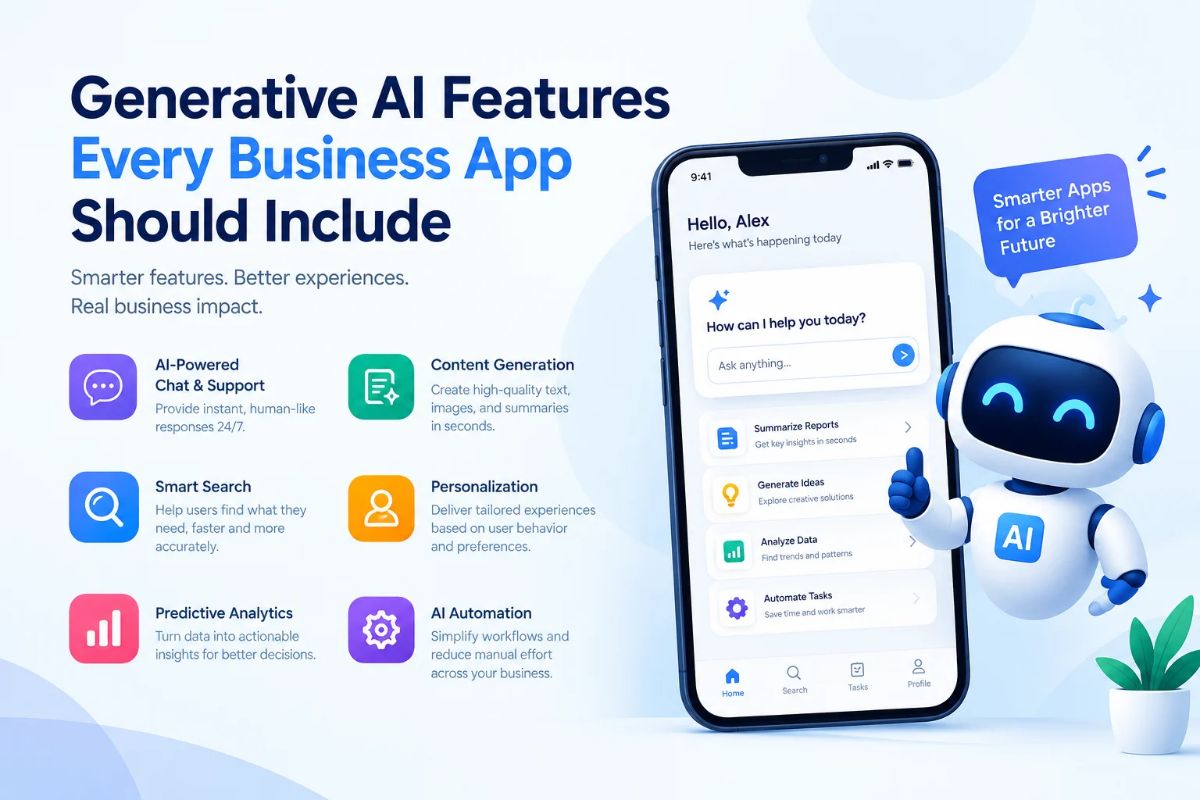
Generative AI is changing the way people interact with mobile applications by making those interactions more conversational and easier to navigate. Instead of asking users to search through menus or figure out where a particular feature is located, an app can let them describe what they need in their own words.
Take an e-commerce app as an example. A customer could enter, “Show me formal shoes for an outdoor event under my budget.” The application can understand the request, identify details such as the occasion, product type, and price range, and then present more relevant options. This makes product discovery feel less like navigating a system and more like having a natural interaction.
Conversational Interfaces and Intelligent Search
AI-powered conversational interfaces are becoming useful across customer support, product discovery, content search, and in-app assistance. Users can ask follow-up questions without having to repeat the entire request, as the system can use the context of the ongoing conversation to provide a more relevant response.
The quality of these experiences depends heavily on the information connected to the application. Product details, customer records, order information, and company documents should be retrieved from trusted and approved sources. Keeping the underlying data reliable helps reduce the risk of presenting users with information that has not been properly verified.
AI-Generated Content
Generative AI can also help applications create useful content from information already available within the platform. For instance, a productivity app could turn a lengthy document into a shorter summary, while a learning platform could explain a complex topic in a way that matches the learner’s needs.
However, generated content still requires appropriate checks before it is presented as reliable information. This becomes especially important in applications where users may use the output to make decisions or act on the information provided.
On-Device AI Is Changing Mobile App Architecture
AI processing is no longer limited to remote cloud servers. Mobile platforms are increasingly supporting AI workloads directly on compatible devices. Android provides on-device generative AI capabilities through Gemini Nano, while Apple’s developer ecosystem includes Foundation Models for integrating on-device intelligence into applications.
Processing selected tasks locally can reduce network dependency and improve responsiveness. It can also support certain offline experiences and keep appropriate data on the device instead of sending every request to a remote service.
However, mobile hardware varies significantly across devices. A model that performs well on one smartphone may not provide the same experience on another. Developers therefore need to consider memory, processing capability, battery consumption, operating-system support, and model size.
This is where hybrid architecture becomes useful. Lightweight tasks can run locally, while more complex requests are handled through cloud-based models. A mobile app development company in USA working on an AI-powered product may therefore need to determine which workloads belong on the device and which should be processed remotely.
AI Is Making Mobile Apps More Personalized
AI is taking personalization beyond simple recommendation rules. Instead of showing the same experience to every user, applications can analyze permitted behavioral signals and adjust content or recommendations according to individual patterns.
An e-commerce application can consider browsing behavior, previous purchases, search activity, and stated preferences when ranking products. A streaming platform can use viewing patterns to improve content recommendations. Similarly, an educational application can identify areas where a learner needs additional practice and adjust the material accordingly.
The difference is that AI can identify relationships across multiple signals that may be difficult to represent through manually written rules.
However, personalization also creates responsibility around data usage. Businesses need to understand which information is necessary, obtain appropriate permissions, protect stored data, and provide users with transparency about how their information is used.
Predictive AI Is Helping Apps Anticipate User Needs
Mobile applications traditionally focus on displaying current information. Predictive AI allows them to analyze historical and real-time data to identify patterns and anticipate possible outcomes.
This capability can support fraud detection, demand forecasting, delivery-time prediction, customer churn analysis, inventory planning, and risk assessment.
Consider a logistics application. Rather than simply showing where a delivery vehicle is located, an AI system could analyze available route information and identify a potential delay. The application can then alert the relevant user so corrective action can be taken.
For financial applications, predictive models can help identify unusual transaction behavior. In retail, they can assist with demand forecasting. In healthcare applications, they may support analysis of available information where appropriate safeguards and professional oversight are in place.
The mobile interface becomes the point where these predictions are presented in a form users can act upon.
Computer Vision and Voice AI Are Expanding Mobile Capabilities
Smartphones provide cameras, microphones, sensors, and other hardware that can act as inputs for AI-powered features. This allows applications to interact with users and their surroundings in ways that were difficult to implement previously.
Computer vision can support document scanning, text extraction, object recognition, visual search, product identification, image classification, and identity verification. For example, a retail application could allow a customer to photograph an item and search for visually similar products.
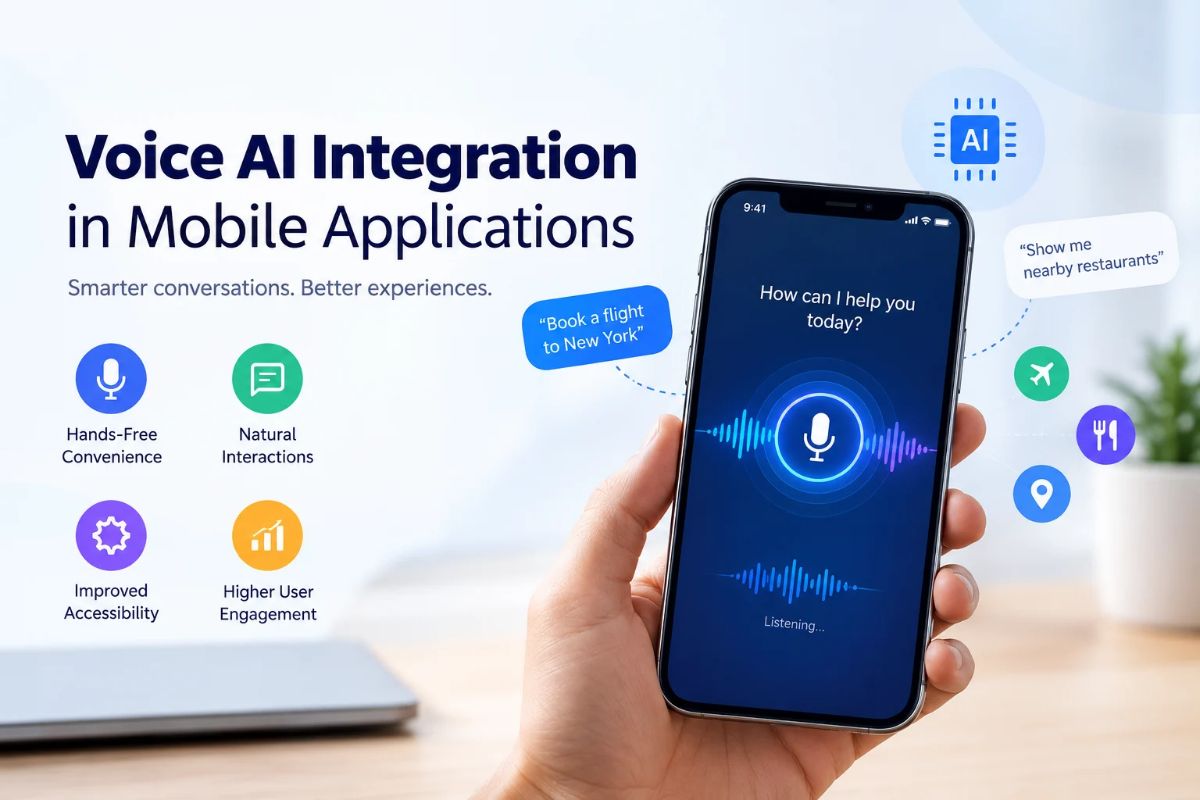
Voice AI provides another interaction channel. Users can ask questions, dictate information, or perform selected actions without typing. This can be especially useful in situations where hands-free interaction is more convenient.
For a mobile app development company in USA, implementing these capabilities involves more than connecting an application to an AI model. Camera quality, speech accuracy, background noise, processing speed, device compatibility, and privacy all affect the final experience.
AI Agents Are Turning Apps Into Action-Oriented Platforms
AI agents are taking mobile applications beyond simple question-and-answer interactions. Instead of only generating a response, an agent can interpret a goal, determine the steps involved, use approved tools, and assist with completing a workflow.
For example, a travel application could receive a request for a trip that meets specific requirements. The agent could search available information, compare suitable options, and prepare the next step for the user.
This type of system requires careful engineering because the AI may interact with business systems through APIs. Actions such as making payments, placing orders, changing account information, or confirming bookings should not be left entirely to a model.
Developers can instead expose controlled functions with defined permissions. The AI determines which approved capability may be useful, while application logic validates the action and, where necessary, asks the user for confirmation.
This combination allows businesses to introduce automation without giving an AI system unrestricted control over critical operations.
Security and Privacy in AI-Powered Mobile Apps
AI introduces additional security considerations because mobile applications may process personal information, financial records, documents, conversations, images, or voice data.
A secure AI application should establish clear controls over what information is collected and where that information is processed. Developers also need to protect communication between the application and backend services through appropriate authentication, authorization, encryption, and secure API design.
AI-specific risks also require attention. Applications using generative models may need protection against prompt injection, unauthorized data exposure, manipulated inputs, and unreliable model responses.
Privacy should also influence architectural decisions. If a task can be performed effectively on the device without sending sensitive information to an external service, local processing may be worth considering.
For this reason, businesses evaluating a mobile app development company in USA should look at AI security as part of the development strategy rather than treating it as a final-stage requirement.
Conclusion
As AI continues to reshape mobile app development, its real value lies in how effectively businesses apply these capabilities to create useful, secure, and scalable digital products. Generative AI, predictive analytics, computer vision, voice interaction, and on-device intelligence are expanding what mobile apps can deliver while introducing new considerations around privacy, performance, and scalability. With the right technical approach, these capabilities can become practical solutions for specific business and user needs. Devherds helps businesses bring these ideas to life through AI strategy, UI/UX design, mobile engineering, backend development, integrations, testing, deployment, and ongoing support. We also offer a free 30-minute strategy call to discuss your app idea, requirements, and roadmap. Reserve your slot today and take the first step toward turning your vision into a smarter mobile experience.