Mobile applications are becoming more intelligent, connected, and responsive as new technologies expand what smartphones and other mobile devices can do. For businesses in the USA, this shift is creating new ways to personalize customer experiences, automate routine processes, and connect digital services with physical environments. As these capabilities become part of mainstream products, choosing the right mobile app development company USA also means finding a team that understands how emerging technologies can be applied to real business requirements. Artificial intelligence, on-device processing, augmented reality, edge computing, IoT, predictive analytics, and passwordless authentication are opening new possibilities across industries. This blog explores the technologies driving that change and the business applications they are enabling.
Artificial Intelligence Is Reshaping Mobile App Experiences
Artificial intelligence is becoming a core component of mobile applications rather than a standalone feature added for experimentation. Businesses are using AI to make apps more responsive to user behavior, automate repetitive processes, interpret large amounts of information, and provide assistance within existing workflows.
For a mobile app development company in USA, this means AI integration increasingly involves more than connecting an application to a language model. Developers need to determine which business processes can genuinely benefit from intelligent automation and how AI should interact with existing application logic.
Generative AI for Personalized Experiences
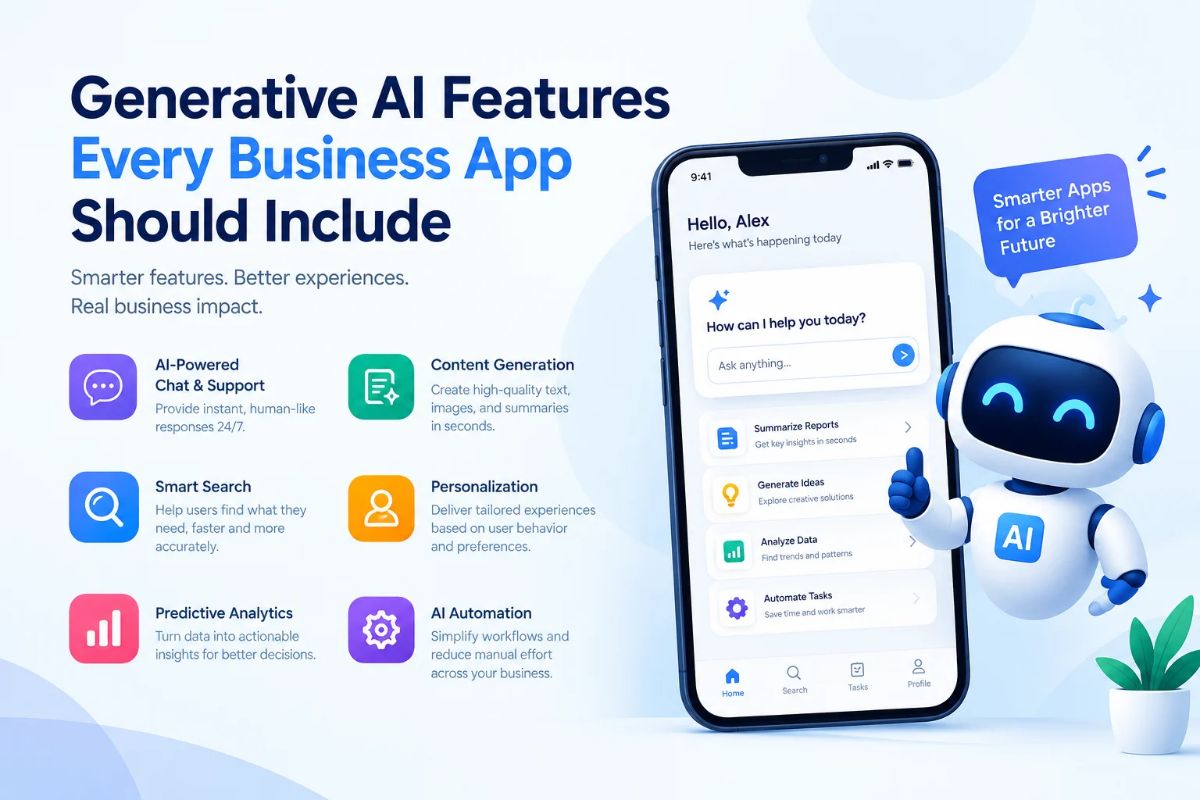
Generative AI can create more natural interactions between users and applications. Instead of navigating several menus or searching through large amounts of information, users can describe what they need in everyday language.
An ecommerce application, for example, can understand a request such as finding a business-casual outfit for a particular occasion. A financial application can summarize account activity in simpler language, while an enterprise application can turn lengthy reports into concise action points.
This makes mobile applications more adaptive without requiring businesses to create a separate interface for every possible user need.
AI-Powered Recommendations
Recommendation systems are also becoming more sophisticated. Rather than relying only on basic purchase or browsing history, AI can consider multiple behavioral signals to identify products, services, content, or actions that may be relevant to an individual user.
Retail, entertainment, travel, food delivery, and financial applications can all use this capability to make their interfaces more relevant and reduce the effort required to find useful information.
AI Agents Are Moving Mobile Apps From Answers to Actions
The next stage of mobile AI is moving beyond systems that simply respond to questions. AI agents can interpret a user’s objective, work with connected tools, retrieve relevant information, and complete multiple steps within a defined workflow.
This can change the role of an application from an information platform into an active digital assistant.
How AI Agents Can Support Businesses
A customer service app could allow an agent to identify an order, determine the issue, and initiate an eligible resolution. A travel application could help organize a trip by combining information from flights, hotels, calendars, and other connected services.
Within business applications, agents can also assist with:
- Scheduling and appointment management
- Customer support
- Document processing
- Sales assistance
- Order management
- Internal knowledge retrieval
- Workflow automation
- Employee support
The important factor is controlled execution. Businesses need clear permissions and approval mechanisms when an AI agent can perform actions rather than simply provide information.
Augmented Reality Is Creating More Interactive Business Apps
Augmented reality is shifting mobile applications from displaying information on a screen to placing digital information within the user’s physical surroundings.
The technology has practical applications beyond entertainment and promotional filters. Businesses can use AR to help customers visualize products, guide employees through physical tasks, or provide interactive information based on the user’s environment.
AR in Retail and Ecommerce
Furniture retailers can allow customers to preview how products may look within a room. Automotive businesses can create interactive vehicle experiences, while fashion and beauty applications can support virtual product visualization.
These experiences can help customers understand a product before purchasing it, particularly when size, appearance, or placement influences the buying decision.
AR for Business Operations
AR can also support employees.
A field-service worker could access visual instructions while examining equipment. A warehouse employee could receive location-based guidance while handling inventory. A technician could view relevant information without repeatedly switching between a physical task and a separate reference system.
This makes AR particularly useful when mobile technology needs to connect digital information with real-world work.
Spatial Computing Is Expanding Mobile Experiences Beyond the Screen
Spatial computing takes the idea of immersive interaction further by allowing digital content to exist within three-dimensional environments.
While spatial computing represents a smaller market than conventional smartphone applications, businesses are beginning to explore its potential for specialized workflows involving visualization, training, collaboration, and guided work.
Enterprise Applications of Spatial Computing
Manufacturing businesses can use three-dimensional models to examine designs or support training. Healthcare organizations can explore immersive visualization for education and specialized workflows. Transportation and engineering companies can use spatial environments to present complex information in a more intuitive format.
For businesses exploring these experiences, spatial computing should be connected to a specific operational or customer requirement rather than treated as an additional visual feature.
IoT and Wearables Are Extending Mobile Apps Into Connected Ecosystems
Mobile applications are no longer limited to information entered manually by users. Smartphones can communicate with wearables, vehicles, sensors, appliances, and other connected devices, creating a broader digital ecosystem.
This is particularly relevant for businesses that depend on continuous data.
Connected Devices and Business Applications
A fitness application can combine smartphone activity with wearable data. Logistics platforms can connect driver applications with vehicle information. Industrial businesses can connect mobile applications to equipment and sensors.
The mobile app becomes the interface through which users interpret information collected from multiple sources.
The challenge is ensuring that information remains synchronized across devices and backend systems. A connected experience is only useful when the data presented to users is timely, accurate, and consistent.
Predictive Analytics Is Making Mobile Apps More Proactive
Traditional applications generally wait for users to perform an action. Predictive technologies allow applications to identify patterns and provide information before a user specifically asks for it.
Businesses can use predictive analytics to identify likely customer behavior, operational issues, demand changes, or unusual activity.
Predictive Applications Across Industries
Retail businesses can use historical and behavioral data to anticipate demand. Financial applications can identify unusual transaction patterns. Logistics platforms can analyze operational data to identify potential delays. Subscription businesses can study engagement patterns to identify customers who may require additional attention.
This moves mobile applications from passive tools toward more proactive business systems.
The quality of these predictions depends heavily on the quality and relevance of the underlying data. Businesses therefore need reliable data pipelines and ongoing model monitoring rather than treating predictive analytics as a one-time implementation.
Computer Vision Is Bringing Visual Intelligence to Mobile Apps
Modern smartphones contain cameras capable of capturing detailed visual information, creating opportunities for applications that can understand images and physical objects.
Computer vision can identify objects, read documents, detect visual patterns, and support image-based workflows.
Practical Business Uses of Computer Vision
Retail applications can use visual search to help customers find products. Insurance applications can support image-based claim documentation. Logistics platforms can use scanning and recognition capabilities to improve inventory workflows.
Manufacturing and field-service applications can also use computer vision to assist with inspections and identify specific visual conditions.
When combined with AI, computer vision can make the smartphone camera an intelligent input mechanism rather than simply a tool for capturing photographs.
How These Technologies Are Changing US Business Applications
The biggest change is not the introduction of any individual technology. It is the way multiple technologies can work together inside one application.
An ecommerce app could combine generative AI, recommendations, computer vision, and AR. A logistics platform could combine IoT, edge computing, predictive analytics, and real-time location services. An enterprise application could combine AI agents, voice interaction, secure authentication, and cloud infrastructure.
This convergence allows businesses to build applications around complete workflows rather than isolated features.
For a mobile app development company in USA, the challenge is consequently shifting from simply implementing individual technologies to designing an architecture in which those technologies work reliably together.
Conclusion
Emerging technologies are changing how US businesses connect with customers, streamline operations, and deliver digital services. AI, connected devices, spatial experiences, predictive capabilities, and stronger authentication are opening new possibilities, but their value depends on how thoughtfully they are applied to real business requirements. To help you turn these opportunities into a practical product, Devherds combines strategy, UI/UX design, engineering, AI integration, testing, deployment, and ongoing support. We also provides a free 30-minute strategy call where you can discuss your app idea, business requirements, target users, key features, technology needs, and development roadmap with our experts. Connect with us and start planning your next digital product today.