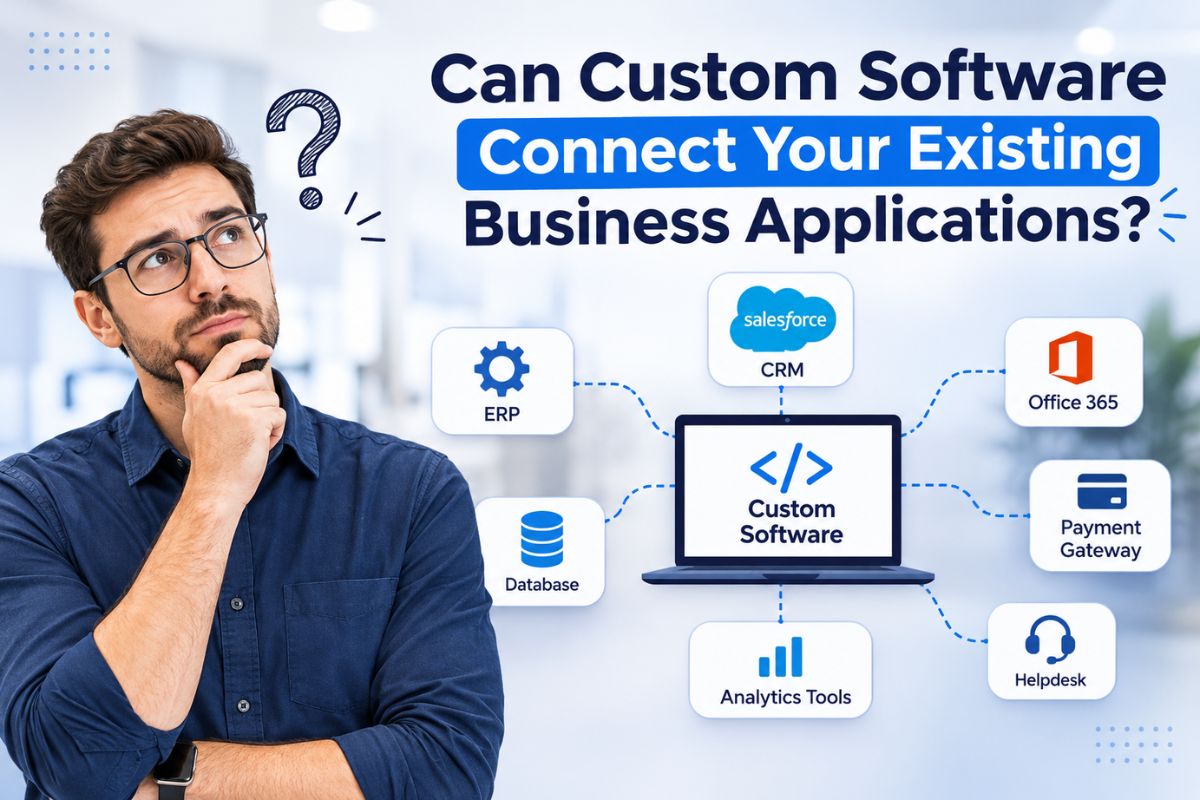
To perform daily tasks, most businesses utilize a number of business applications to handle customer data, make payments, handle software records, etc. However, when each tool operates separately, complications arise in terms of timely data exchange among departments. There may be cases when employees are exhausted from entering the same information many times into many applications or are constantly forced to switch from one application to another to accomplish even minor everyday operations. But software development services can help address these problems by integrating already used business applications without the necessity of their replacement. But how feasible is the approach, and what should be taken into account when connecting these applications together? In this blog, we will explore these aspects and understand how custom software integration works.
How Does Custom Software Integration Work?
The integration process depends on the applications involved, the type of information being exchanged, and the desired level of automation. Developers generally use different technologies and approaches to establish communication between systems.
Here are some common methods used to connect business applications.
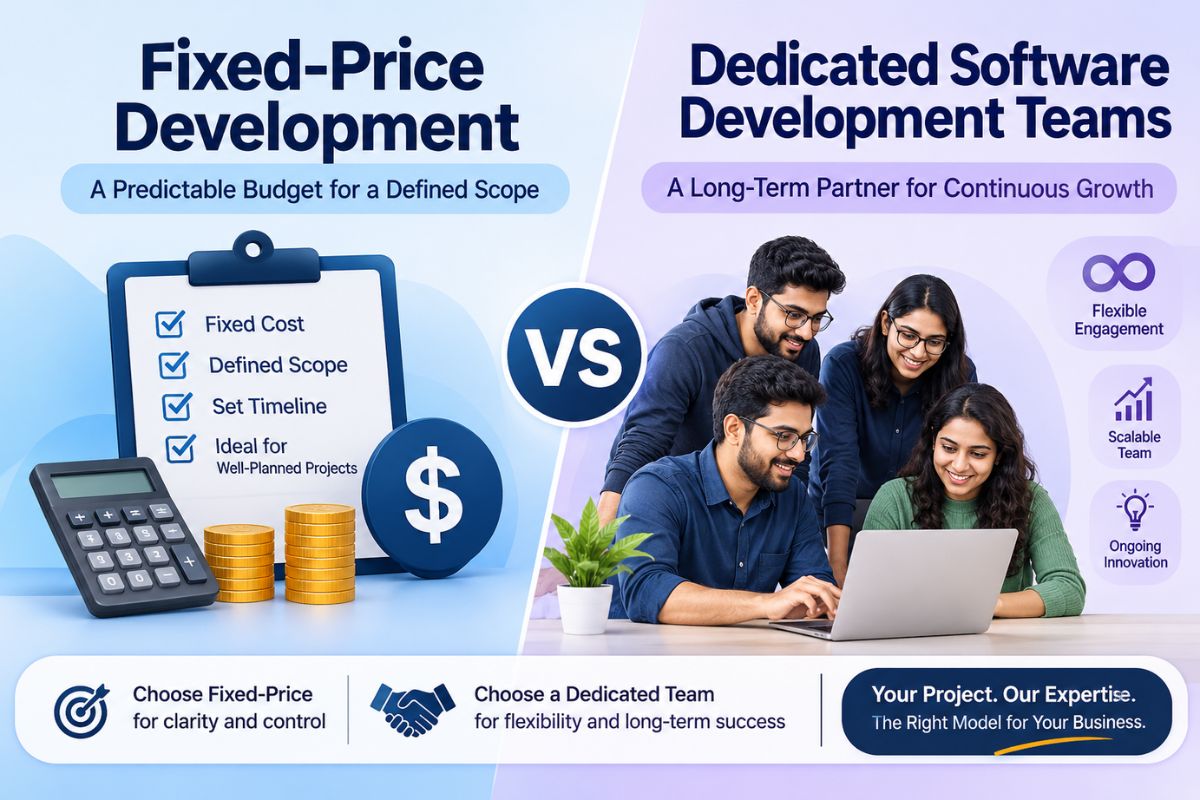
Also read: Fixed-Price Development vs Dedicated Software Development Teams
1. API Integration
Application Programming Interfaces (APIs) are among the most widely used methods for connecting different software applications. An API allows one application to request information or functionality from another through predefined communication rules.
For example, an eCommerce website can use a payment gateway API to process transactions. Once a payment is completed, the gateway can send a response that allows the website to update the order status.
Similarly, a CRM can communicate with an email marketing platform through APIs to share customer details and subscription preferences.
Custom development can create new APIs or work with existing ones to establish the required connections. Developers also define which information can be accessed, how requests are handled, and what responses should be returned.
2. Middleware Integration
Middleware works as an intermediary between two or more applications. Instead of requiring every system to communicate directly with all the others, middleware manages information exchange through a central integration layer.
For example, a business using CRM, ERP, accounting, and inventory applications can connect them through middleware. When one application sends information, the middleware can process it, convert the data into the required format, and forward it to the appropriate system.
This approach can simplify integrations when several applications need to communicate regularly. It also makes it easier to introduce additional systems without creating numerous separate connections.
3. Database Integration
Some applications need to access or share information stored in different databases. Database integration establishes a connection that allows authorized systems to retrieve, update, or exchange relevant records.
For example, a reporting application may need information from sales and inventory databases to generate business performance reports.
Developers can create controlled data-sharing mechanisms, synchronization processes, or database connectors to support these requirements. However, directly exposing production databases is not always appropriate. Access permissions, data ownership, and security controls must be considered before establishing such connections.
4. Webhooks and Event-Based Integration
Webhooks allow one application to notify another when a particular event occurs. Instead of continuously checking whether information has changed, the receiving application gets an automated notification.
For instance, when a customer completes a payment, the payment platform can send a webhook to the order management system. The receiving application can then update the order status and initiate the next step in the fulfillment process.
This method is useful when businesses need timely updates without repeatedly requesting information from connected applications.
Which Business Applications Can Be Connected Through Custom Software?
Custom integration can connect several types of business applications, depending on their technical capabilities and the requirements of the organization.
Some common examples include:
CRM and ERP Systems
Connecting Customer Relationship Management (CRM) and Enterprise Resource Planning (ERP) systems allows customer information, sales records, order details, and financial data to move between departments.
For example, when a sales representative updates a customer order in the CRM, the ERP system can receive the relevant details for billing, inventory planning, and order processing.
Accounting and Payment Applications
Businesses can connect accounting platforms with payment gateways and other financial applications to simplify transaction tracking.
Payment confirmations, invoices, refunds, and transaction records can be exchanged automatically. This reduces manual updates and helps finance teams maintain consistent financial information.
Inventory and Order Management Systems
Retailers and distributors often use separate applications to manage stock levels and process orders.
Integration allows these systems to share information about product availability, incoming orders, dispatch details, and stock movements. When an order is placed, inventory records can be updated to reflect the latest available quantity.
HR and Payroll Applications
Human Resource Management Systems (HRMS) and payroll applications can share employee information, attendance records, leave details, and salary-related data.
For example, approved attendance information can be transferred to payroll software to support salary calculations without requiring repeated manual entries.
eCommerce and Marketing Platforms
An eCommerce platform can connect with CRM and marketing applications to share customer information, purchase histories, and order details.
Marketing teams can use this information to manage customer segments, personalize communication, and coordinate promotional activities.
What Should Businesses Consider Before Integrating Their Applications?
Although connecting applications can simplify operations, successful integration requires proper planning. Businesses need to understand how their existing systems work and what they expect from the connected environment. Choosing the right software development services can help evaluate technical requirements and establish an integration approach that works with existing applications.
The following considerations can help guide the process.
1. Compatibility of Existing Applications
Not every application supports the same integration methods. Some provide well-documented APIs, while others may offer limited connectivity options or require additional development.
Before starting, developers should examine the technical capabilities of each application, including supported protocols, data formats, authentication methods, and available integration interfaces.
This helps determine which approach is suitable and whether additional connectors or custom components are required.
2. Data Mapping and Consistency
Different applications may store similar information using different field names, formats, or structures. For example, one system might identify a customer through an email address, while another uses a unique customer ID.
Developers need to establish clear data-mapping rules so that information is transferred accurately between applications.
They should also define which system acts as the primary source for particular records. This prevents conflicting updates and makes it easier to maintain consistent information across connected platforms.
3. Security and Access Control
Integrated applications may exchange sensitive information, including customer details, financial records, and employee data. Therefore, security needs to be considered throughout the development process.
Businesses should implement secure communication protocols, appropriate authentication mechanisms, and role-based access permissions. Applications should only receive the information required to perform their assigned functions.
Regular monitoring, access reviews, and proper credential management can further reduce the risk of unauthorized access.
4. Error Handling and System Reliability
An integration may encounter problems if an application becomes temporarily unavailable, an API request fails, or the information received does not match the expected format.
Developers should establish error-handling mechanisms to identify failed requests and prevent important updates from being lost.
Depending on the integration requirements, this may include retry mechanisms, error logs, notification systems, and message queues. These measures help businesses identify issues and maintain reliable communication between applications.
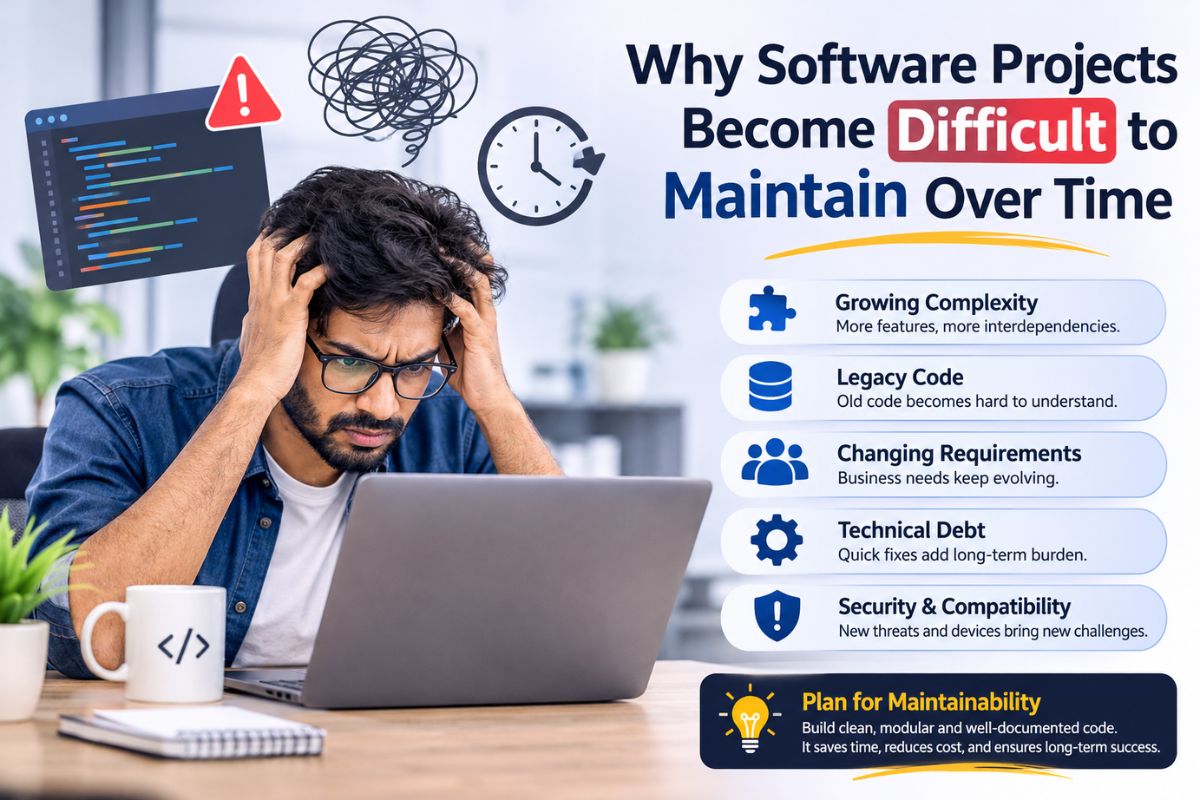
Alsor Read: Why Software Projects Become Difficult to Maintain Over Time
5. Future Scalability and Maintenance
Business requirements rarely remain the same for long periods. A company may introduce additional applications, expand its operations, or change its existing workflows.
The integration architecture should accommodate these changes without requiring the entire connection system to be rebuilt.
Developers should also plan for API updates, software upgrades, performance monitoring, and ongoing maintenance to keep the integrated environment functional.
What Are the Benefits of Connecting Business Applications Through Custom Software?
Once existing applications communicate effectively, businesses can improve several aspects of their daily operations.
- Reduced manual work: Automated information exchange minimizes repeated data entry and allows employees to focus on other responsibilities.
- Better data accuracy: Synchronizing records helps reduce discrepancies between departments and applications.
- Faster business processes: Information reaches the relevant systems without unnecessary manual intervention, helping teams complete tasks more efficiently.
- Improved decision-making: Managers can access information from different departments to understand business performance and identify areas that need attention.
- Greater control over workflows: Custom integrations can follow specific operational rules instead of forcing businesses to adjust their processes around generic connectors.
- Better use of existing investments: Companies can extend the capabilities of their current applications without immediately replacing established software.
These advantages depend on the quality of the integration, the reliability of connected applications, and how well the solution supports actual business requirements.
Conclusion
Connecting existing business applications through custom software can help companies reduce manual work, improve information sharing, and establish more coordinated operations. Instead of replacing familiar tools, businesses can make them work together through suitable integration methods. However, compatibility, data accuracy, security, and future maintenance should be considered before development begins. Devherds provides custom software development services and integration solutions designed around specific business requirements. Our team helps businesses connect their applications, streamline workflows, and make better use of their existing technology investments. Get in touch with us today to schedule a free 30-minute strategy call and discuss your integration requirements.