
Mobile applications have become an essential part of modern businesses. From online shopping and banking to healthcare, education, and business management, people use mobile apps to access services and share personal information every day. However, as mobile applications handle more sensitive data, security has become a major concern for developers and businesses.
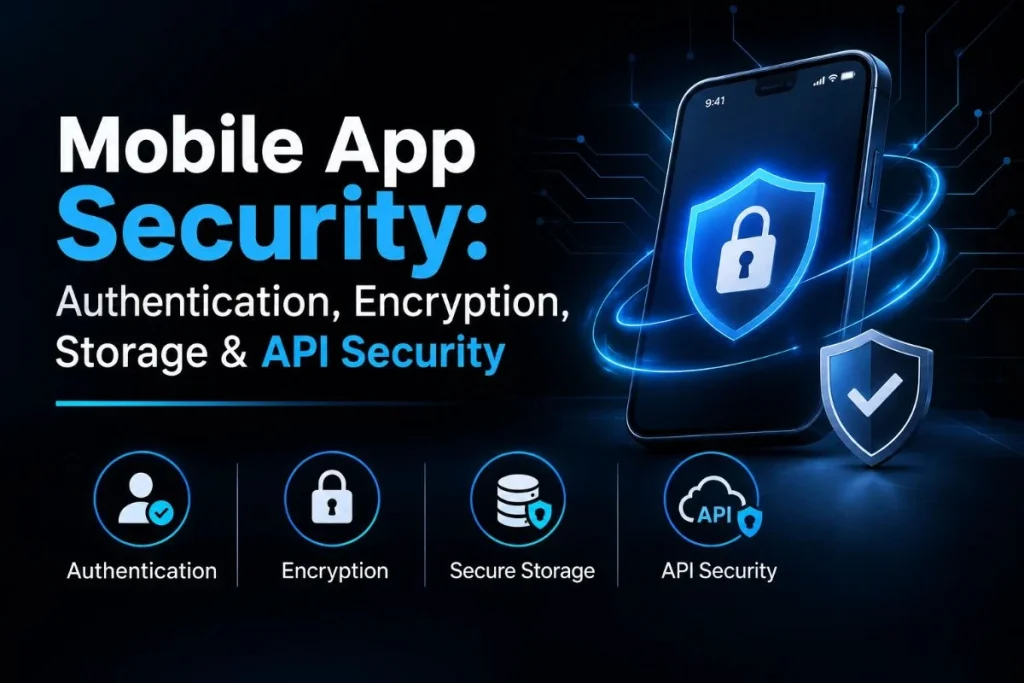
A mobile application is not secure simply because it has a password or login screen. Strong protection requires multiple security measures working together, including authentication, data encryption, secure storage, and API security.
A single security weakness can expose customer information, interrupt business operations, damage brand reputation, and create financial losses. Therefore, businesses should consider security from the beginning of the mobile app development process rather than treating it as a final testing activity.
In this guide, we will explore the essential elements of mobile app security, common vulnerabilities, practical protection methods, and ways businesses can build applications that users can trust.
Why Is Mobile App Security Important?
Mobile applications often collect and process sensitive information, such as:
-
Personal details, including names, email addresses, and phone numbers.
-
Login credentials and account information.
-
Payment details and transaction records.
-
Business documents and confidential information.
-
Location data and device-related information.
-
Health records and other private information.
If attackers gain access to this information, the consequences can extend beyond individual users. Businesses may face regulatory issues, financial damage, customer complaints, and loss of trust.
For example, imagine an eCommerce application where attackers discover a weakness in the login system. They might attempt to access customer accounts, view personal details, or misuse saved payment-related information.
This is why mobile app security should cover the entire application environment, including the device, application code, backend infrastructure, databases, and communication channels.
1. Authentication: Protecting User Accounts
Authentication is the process of verifying whether someone is actually the person they claim to be. It is usually the first security layer users encounter when opening an application.
However, traditional username and password authentication may not provide enough protection on its own.
Use Multi-Factor Authentication (MFA)
Multi-factor authentication adds another verification step before allowing account access.
For example, users may need to provide:
-
Something they know, such as a password.
-
Something they have, such as a registered device or security key.
-
Something they are, such as a fingerprint or facial recognition.
Even if someone obtains a user’s password, an additional authentication requirement can make unauthorized access more difficult.
Implement Secure Password Policies
Businesses should encourage users to create strong passwords and avoid easily guessed combinations.
Developers should also ensure that passwords are never stored in plain text. Passwords should be protected using suitable password-hashing algorithms, such as Argon2id or bcrypt, with appropriate configurations.
Consider Biometric Authentication
Fingerprint and facial recognition can improve the login experience while adding another security option.
However, developers should use the device’s trusted biometric authentication mechanisms instead of storing biometric information directly inside the application.
2. Encryption: Keeping Sensitive Information Protected
Encryption is one of the most important parts of mobile application security. It converts readable information into an unreadable format so unauthorized individuals cannot easily understand the data, even if they manage to access it.
Mobile applications should use encryption to protect information both when it is stored and when it travels between the application and the server.
Data Encryption in Transit
Whenever a mobile application communicates with a backend server, information travels through a network. Without proper protection, attackers may attempt to intercept this communication.
Developers should use HTTPS with modern TLS configurations to secure data transmission.
This helps protect:
-
Login credentials.
-
Customer information.
-
Payment-related communication.
-
API requests and responses.
-
Other confidential application data.
Data Encryption at Rest
Encryption at rest protects information stored on devices, servers, and databases.
For example, if an application stores customer information locally, developers should avoid keeping sensitive records in easily accessible files.
Appropriate encryption methods and secure key management help reduce the risk of data exposure if a device is lost, stolen, or compromised.
Manage Encryption Keys Carefully
Encryption is only effective when its keys are properly protected.
Developers should avoid hardcoding encryption keys into application source code. Keys should be managed through appropriate secure key-management systems, such as platform-backed keystores or dedicated key-management services.
3. Secure Storage: Protecting Data on Mobile Devices
Mobile applications sometimes need to store information locally to improve performance and provide offline functionality.
However, insecure storage can create serious privacy and security problems.
For example, storing authentication tokens, passwords, or personal information in plain-text files may allow attackers to access sensitive data if they gain access to the device.
Use Secure Storage Solutions
Both Android and iOS provide security mechanisms that developers can use to protect sensitive information.
-
Android Keystore: Helps securely manage cryptographic keys.
-
iOS Keychain: Provides protected storage for sensitive items, such as credentials and tokens.
-
Encrypted databases: Help protect locally stored application information.
-
Secure session management: Reduces the risk of unauthorized access through stolen or exposed session tokens.
Avoid Storing Unnecessary Information
One effective security practice is to collect and store only the information an application genuinely needs.
For instance, an application does not necessarily need to save payment credentials or personal details permanently on a user’s device.
Reducing unnecessary data storage limits the amount of information that could be exposed during a security incident.
Protect Application Backups and Logs
Developers should also review how application data is included in device backups and system logs.
Sensitive information should not appear in debugging messages, crash reports, or unprotected backup files.
4. API Security: Protecting Communication Between Apps and Servers
APIs (Application Programming Interfaces) allow mobile applications to communicate with backend systems, databases, payment services, and third-party platforms.
Although APIs make modern applications more powerful, they can also introduce security risks when developers do not implement proper access controls.
For example, a mobile application may allow users to view their account information through an API. If the backend does not properly verify ownership, an attacker might attempt to access another user’s records by changing an account identifier in the request.
Implement Strong API Authentication
Every sensitive API request should be properly authenticated.
Depending on the application architecture, developers can use secure token-based authentication, OAuth 2.0, or OpenID Connect.
Access tokens should have appropriate expiration periods, and refresh-token handling should be designed carefully.
Apply Authorization Checks
Authentication confirms who the user is, while authorization determines what that user can access.
Developers should enforce authorization checks on the server rather than relying only on restrictions inside the mobile application.
For example, a regular customer should not be able to access administrator functions simply by modifying an API request.
Validate API Requests
Every API request should be checked before processing.
Important practices include:
-
Validate incoming data and request parameters.
-
Restrict access to sensitive endpoints.
-
Apply rate limiting to prevent excessive requests.
-
Use appropriate input validation.
-
Avoid exposing confidential information in API responses.
-
Monitor unusual API activity.
These measures help reduce risks such as unauthorized access, injection attacks, and automated abuse.
5. Common Mobile App Security Vulnerabilities
Understanding common vulnerabilities helps development teams identify potential problems before attackers exploit them.
| Security vulnerability | Possible impact |
|---|---|
| Weak authentication | Unauthorized account access |
| Insecure data storage | Exposure of personal information |
| Poor encryption | Interception or misuse of sensitive data |
| Insecure APIs | Unauthorized access to backend resources |
| Hardcoded credentials | Exposure of application secrets |
| Improper session management | Account takeover risks |
| Outdated dependencies | Exploitation of known vulnerabilities |
One important point is that these weaknesses are not always visible during normal application use. An app may work perfectly from a user’s perspective while still containing serious security flaws.
This is why security testing should be part of the development lifecycle.
6. Best Practices for Building Secure Mobile Applications
Businesses planning a new mobile application should establish security requirements before development begins.
Here are some practical recommendations:
-
Follow secure coding practices: Write application code that minimizes common security weaknesses.
-
Use modern authentication: Implement MFA and secure session management where appropriate.
-
Encrypt sensitive information: Protect data during transmission and storage.
-
Secure APIs: Apply authentication, authorization, validation, and rate limiting.
-
Update third-party libraries: Regularly review dependencies for known vulnerabilities.
-
Perform security testing: Conduct code reviews, vulnerability assessments, and penetration testing.
-
Monitor application activity: Identify unusual login attempts, suspicious API requests, and potential security incidents.
-
Plan security updates: Maintain a process for fixing vulnerabilities after the application is released.
Businesses can also use established security guidance, including the OWASP Mobile Application Security Verification Standard (MASVS), to structure their mobile application security requirements and testing activities.
7. Why Security Testing Should Not Be Delayed
Many businesses focus on launching their applications quickly and plan to address security issues later. This approach can create unnecessary risks.
Security testing should happen at different stages of development, including:
-
During development: Review code and identify insecure implementation practices.
-
Before launch: Test authentication, encryption, APIs, and data storage.
-
After launch: Monitor vulnerabilities and release security patches.
-
During maintenance: Review third-party components and update outdated dependencies.
Regular security assessments help businesses identify weaknesses before they become serious problems.
8. Choosing the Right Mobile App Development Company
Building a secure application requires more than technical knowledge. Businesses need a development partner who understands their requirements, selects suitable technologies, and considers security throughout the development process.
This is where choosing the right development company becomes important.
Devherds provides digital development solutions, including Mobile App Development, Android App Development, iOS App Development, Cross-Platform App Development, Web Development, E-Commerce Solutions, UI/UX Design, Software Development, and AI Development. The company also offers Digital Marketing and SEO services to support businesses beyond development.
One useful starting point is its free 30-minute strategy call. Businesses can discuss their application ideas, required features, security expectations, development approach, estimated timeline, and budget before moving forward.
This initial discussion can help business owners understand their project requirements and make more informed development decisions.
Final Thoughts
Mobile app security is not a single feature that developers can add at the end of a project. It is a combination of multiple practices that protect users, business information, and application infrastructure.
Authentication helps verify users, encryption protects sensitive information, secure storage reduces data exposure, and API security protects communication between applications and backend systems.
When these elements work together, businesses can create mobile applications that are more reliable, secure, and trustworthy.
Whether you are planning a new application or improving an existing one, investing in security from the beginning can help prevent costly problems in the future.
Planning a secure mobile application? Connect with Devherds through its free strategy call to discuss your project idea, technical requirements, development timeline, and estimated budget.


