Artificial intelligence isn’t just something teams play around with in R&D labs anymore. It’s now a primary driver for how companies build software, automate daily tasks, and interact with customers. Because smart models are becoming easier to integrate, organizations are putting real budget into apps that learn and improve on the fly. That’s why picking the best AI app developer in India matters so much if you want digital tools built to last. Keeping up with the major smart software trends of 2026 helps leaders make sharper technical investments. In this blog, we break down where the industry is heading this year and what it means for your business.
1. The Rise of Autonomous AI Agents in Everyday Apps
Static software that relies strictly on hardcoded rules is quickly becoming obsolete. In 2026, the focal point of intelligent software design has shifted toward autonomous agents, systems capable of executing multi-step workflows with minimal human oversight.
Unlike traditional chatbots that simply answer queries using pre-defined scripts, autonomous agents handle complex, end-to-end tasks. For instance, an agent inside a logistics application can detect a shipping delay, recalculate optimal routes, contact alternative freight suppliers, and update the customer’s delivery window without a manager having to step in.
Key Capabilities Driving Agentic Applications
- Goal-Oriented Reasoning: Break down a broad business objective into practical sub-tasks.
- Tool Orchestration: Interact with external APIs, databases, and third-party software autonomously.
- Self-Correction: Identify execution failures, retry alternative pathways, and refine responses before returning a final output.
For businesses, integrating agentic capabilities means turning passive dashboards into active digital workers, reducing routine operational friction significantly.
2. On-Device AI Processing and Edge Intelligence
Cloud-based inference dominated the initial wave of intelligent mobile features, but latency, rising API costs, and privacy concerns have triggered a massive shift toward edge computing. Modern mobile chipsets feature dedicated Neural Processing Units (NPUs) capable of running compressed large language models directly on the user’s phone.
Why Edge Intelligence Matters for App Architecture
- Zero-Latency Execution: Tasks like real-time voice translation, video rendering, and biomechanical tracking process instantly without waiting for a server round-trip.
- Offline Functionality: Applications maintain their full core intelligence even in low-connectivity environments such as underground transit or remote field sites.
- Data Privacy by Design: Sensitive user information remains stored locally on the client device, simplifying compliance with stringent data protection frameworks.
Engineering lightweight models through quantization and distillation requires deep architectural expertise. Working alongside the best AI app developer in India ensures your software balances on-device responsiveness with cloud-level accuracy.
3. Hyper-Personalization Through Multimodal Interactions
User interfaces are expanding beyond text fields and tap-based navigation. Multimodal applications process voice, text, touch, camera inputs, and spatial data concurrently to build a holistic understanding of context.
Transforming the User Experience Across Domains
- Retail & E-Commerce: Shoppers can snap a photo of a room, speak a preference like “Find a matching mid-century chair under $400,” and view augmented reality overlays of suggested items instantly.
- Healthcare & Wellness: Diagnostics applications analyze voice tone, user logs, and visual images of skin conditions to offer preliminary guidance before a telehealth consultation.
- Corporate Training: Interactive platforms adjust instructional content dynamically based on visual engagement and audio feedback during learning modules.
By combining computer vision with natural language processing, apps move away from generic menus toward intuitive, human-like interaction loops.
4. Generative UI: Dynamic Interfaces Built in Real Time
Historically, design teams spent months mapping out every possible layout variant for different user segments. In 2026, Generative User Interfaces (GenUI) assemble custom screens dynamically based on immediate user intent.
Instead of navigating through four nested menus to pull a quarterly sales record, a user simply types or speaks their request. The app generates a customized dashboard view displaying the exact charts, filtering options, and export buttons required for that specific task.
Benefits of Generative UI
- Drastic Reduction in User Friction: Users accomplish actions in one step rather than hunting through deep navigation trees.
- Context-Aware Adaptability: The interface adjusts its complexity based on whether the user is a novice or a power user.
- Increased Engagement: Apps feel responsive, custom-made, and aligned with individual habits.
Building a flexible backend capable of serving dynamic frontend components safely requires rigorous architectural planning and precise state management.
5. Enterprise-Grade Security, Privacy, and Synthetic Data
As application capabilities grow, security threats evolve alongside them. Prompt injection attacks, data poisoning, and unauthorized access to proprietary models present serious operational risks for enterprise software platforms.
Essential Security Measures for Modern Intelligent Apps
- Guardrail Enforcement: Implementing isolation layers that inspect inputs and outputs to prevent rogue behavior or data leaks.
- Synthetic Data Training: Generating privacy-compliant synthetic datasets to train specialized models without exposing actual customer identifying information.
- Model Lineage Auditing: Documenting every training source, data adjustment, and model revision to maintain full operational transparency.
Companies prioritizing compliance depend on robust architecture. Securing high-grade development talent, such as the best AI app developer in India, helps ensure enterprise products meet strict regulatory protocols while maintaining performance standards.
6. Micro-LLMs and Domain-Specific Model Integration
While general-purpose foundation models handle broad conversations well, enterprise software demands precise, specialized accuracy. The market in 2026 is moving rapidly toward domain-specific Micro-LLMs, smaller models trained exclusively on targeted industry datasets.
Why Micro-Models Are Winning
- Higher Precision: A model fine-tuned on legal contracts or clinical diagnostic records outperforms massive general models on specialized tasks.
- Cost Efficiency: Running compact models dramatically lowers operational infrastructure bills and inference overhead.
- Easier Maintenance: Smaller parameter sizes make updates, retraining, and fine-tuning significantly faster.
Selecting between off-the-shelf APIs, open-source models, or custom-trained micro-models remains a critical technical decision for long-term product viability.
7. Predictive Analytics and Proactive User Workflows
Traditional apps wait for user input before acting. Modern intelligent apps anticipate user actions, offering suggestions and completing setup tasks proactively.
Real-World Proactive Software Applications
- Financial Management: Expense apps identify recurring subscription hikes, flag unusual spending patterns, and auto-draft dispute tickets for user approval.
- Field Service Engineering: Maintenance software predicts machinery wear based on telemetry logs and automatically orders replacement parts before equipment fails.
- Project Management: Team platforms spot project delays early, suggesting resource reallocation options to keep milestones on track.
Proactive software transitions your product from a reactive utility into an irreplaceable operational assistant.
8. Seamless Retrieval-Augmented Generation (RAG 2.0)
Retrieval-Augmented Generation (RAG) bridges external company knowledge bases with generative models. In 2026, RAG has evolved into a real-time, multi-modal system capable of querying live structured databases, unstructured documents, and visual media simultaneously.
Key Advances in RAG Systems
- Hybrid Search Engines: Combining traditional keyword matching with dense vector searches to ensure high retrieval accuracy.
- Self-Refining Queries: Reformulating user requests behind the scenes to fetch exact information from enterprise repositories.
- Citation Verification: Linking generated answers directly to source documents to prevent hallucinations in mission-critical applications.
Building high-throughput RAG systems requires experienced engineering teams capable of managing complex vector indexing and database architecture.
9. Low-Code/No-Code AI Integration Frameworks
To keep pace with market demands, development teams are leveraging specialized low-code platforms to integrate intelligent features faster. These frameworks handle complex infrastructure tasks like API routing, token optimization, and context-window management through drag-and-drop interfaces.
Impact on Product Lifecycles
- Rapid Prototyping: Validate product concepts in weeks rather than spending months on manual backend setup.
- Empowered Business Operations: Allow non-technical managers to adjust prompt workflows without touching core codebase logic.
- Focus on Unique Features: Engineering teams can allocate time toward building proprietary logic rather than reinventing basic plumbing.
While low-code frameworks speed up early releases, scaling those solutions requires hands-on software development expertise to prevent performance bottlenecks down the road.
10. Voice-First Interfaces and Spatial Computing Integration
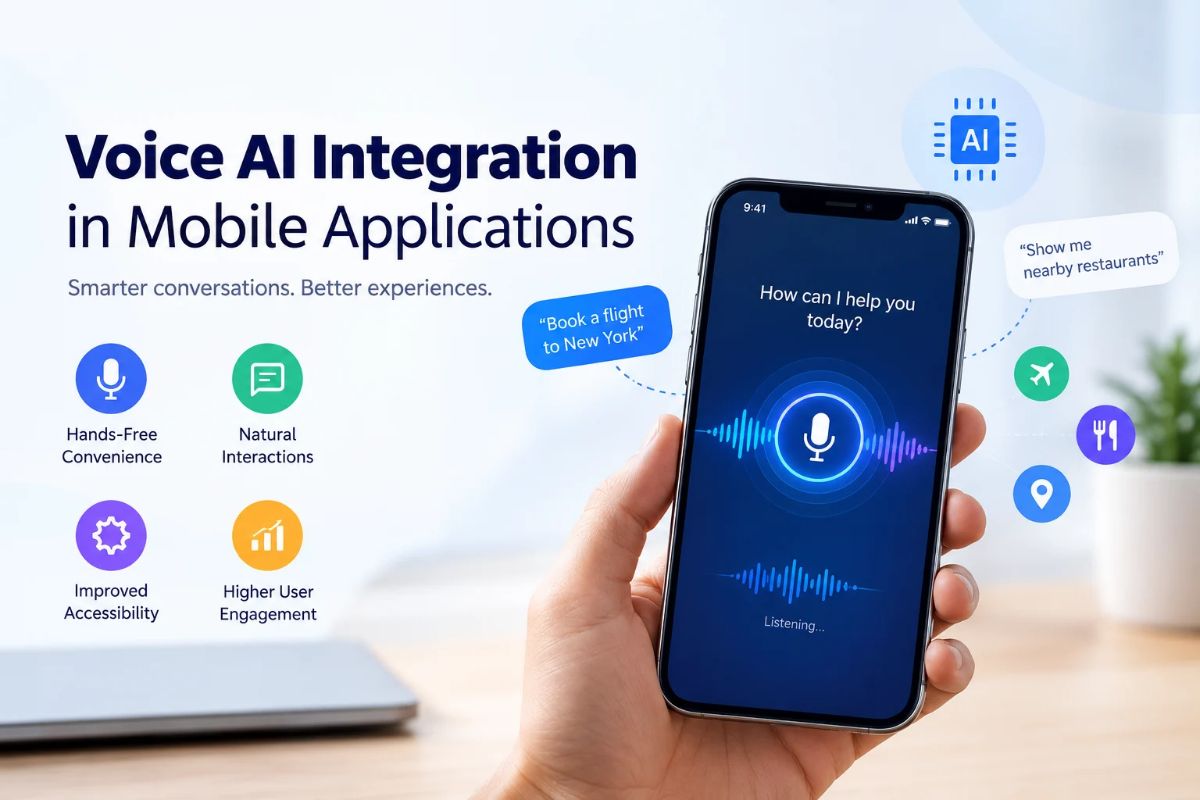
With the rapid expansion of smart wearables and spatial hardware, voice-first interaction models are becoming primary navigation tools. Users expect apps to handle continuous, context-aware speech across multiple languages and subtle dialects seamlessly.
Emerging Spatial and Voice Patterns
- Cross-Device Context: Start a voice conversation on a smart earbud and transition to a spatial workspace interface seamlessly.
- Noise-Resilient Processing: Advanced audio filter models extract clear intent even in noisy outdoor environments.
- Emotional Nuance Detection: Speech engines adjust interaction tone based on user stress signals or voice cadence.
Creating software that coordinates across diverse hardware devices requires strong architectural cohesion and clear cross-platform design strategies.
Conclusion
Navigating the changing technological landscape requires a software partner who understands modern architecture inside and out. At Devherds, we transform complex technical requirements into practical, market-ready digital products.
Our team specializes in designing scalable software solutions, integrating agentic workflows, and engineering high-performance mobile and web applications tailored to your business objectives. Connect with us to start building your product.