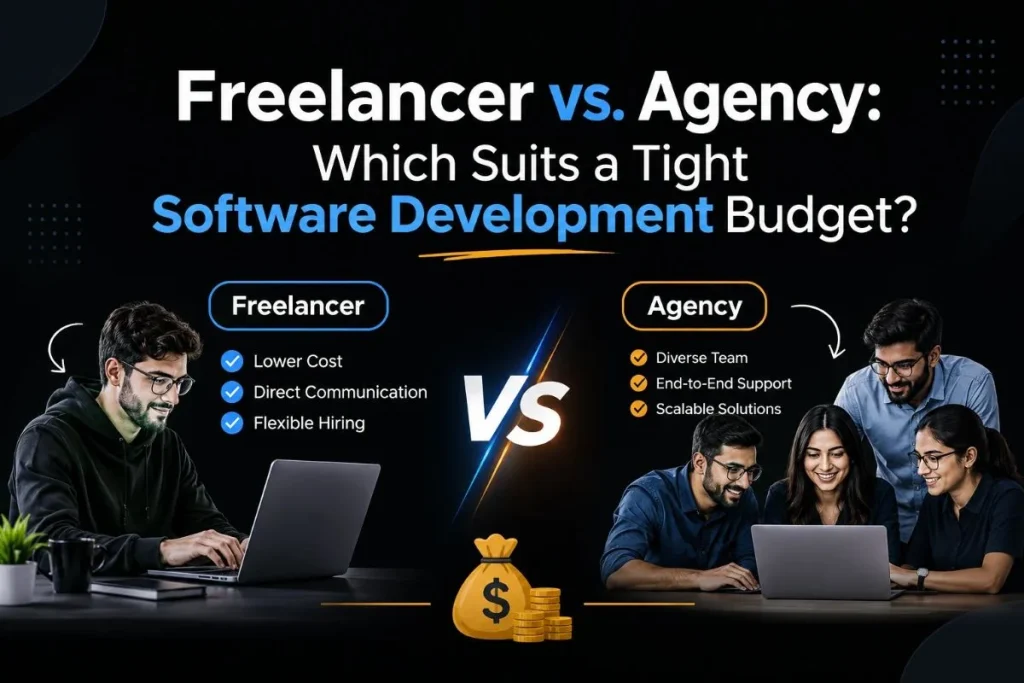
When it comes to hiring a developer for your software project, it is sometimes hard to make the right choice, especially when it comes to costs. Freelancers may carry a lower price, but working with an agency might save you money over time by ensuring that the project runs smoothly, without delays or rework.
Therefore, opting an affordable vendor for your software development needs does not mean picking someone who has the lowest rate. In fact, when it comes to low-budget software development services, one should keep in mind that it’s not about finding someone cheap but finding the one who has the best experience without compromising quality.
Making the wrong choice can bring you unexpected costs and unfinished projects. In this guide, you will know about the differences between hiring a freelancer and a software development agency considering cost, expertise, flexibility, and long-term cooperation.
Freelancer vs. Software Development Agency: What Is the Difference?
Although freelancers and software development agencies offer similar services, their working structures differ. Understanding these differences can help businesses decide which option is more suitable for their project, budget, and internal resources.
Hiring a Freelancer
A freelancer is an independent professional who works directly with clients on specific development assignments. Depending on their expertise, they may handle frontend development, backend programming, database management, UI/UX design, or complete application development.
Freelancers usually have fewer operational expenses, which allows them to offer competitive rates. Businesses can communicate directly with the developer, discuss changes quickly, and negotiate project terms without going through several departments.
Also Read: Where Should Small Businesses Spend Their First Software Budget?
This arrangement works particularly well when the project requirements are clearly defined and do not demand expertise across multiple technical disciplines. However, a freelancer’s ability to manage the entire project depends on their individual skill set, availability, and experience.
Hiring a Software Development Agency
An agency operates through a team of professionals who handle different aspects of software development. Depending on the project, this team may include developers, designers, QA engineers, project managers, and technical consultants.
Instead of relying on one person, businesses can access several specialists working together. Agencies generally follow an organized development process that includes requirement analysis, planning, design, programming, testing, and deployment.
This structure is useful when a project involves multiple features, integrations, or technical challenges. Although agencies may have higher initial charges, businesses do not need to find and coordinate individual professionals for every development requirement.
How Do Freelancers and Agencies Compare in Cost?
Cost differences in project execution are derived from the level of complexity of project, number of people being involved in the project and number of hours taken to finish it.
Freelance Development Pricing
Freelance professionals charge based on a project, hourly basis or monthly basis. Their expenses vary from person to person depending on the experience factor, skills and location.
For example, building a simple webpage, creating a feature in the current website or making a dashboard for the business does not usually require the services of a full development team since an experienced freelancer can execute the tasks individually. This is why employing a freelancer is generally more affordable than taking help from a development agency.
However, often the project cost refers only to the cost of actual development and design, testing, deployment, documentation or maintenance cost is charged separately. Hence if those aspects are not cleared prior to the start of work, one can expect the project cost to increase over time.
Agency Development Pricing
Agencies generally charge more because their estimates account for multiple professionals, project coordination, testing resources, infrastructure, and operational expenses.
Their pricing may cover the entire development cycle rather than just writing code. Businesses can receive assistance with planning, architecture, design, development, quality assurance, deployment, and ongoing support, depending on the selected package.
When evaluating low-budget software development services, businesses should compare what each provider actually delivers. A lower freelance quote may not include essential services, whereas an agency’s estimate may cover a wider scope of work. Comparing the complete cost helps prevent financial surprises later.
Which Is Better for Your Type of Software Project?
The choice between a freelancer and an agency becomes easier when you consider the software you want to build. Different projects require different levels of expertise, coordination, and technical involvement.
Small Projects and MVPs
Freelancers are often suitable for projects with limited functionality, such as landing pages, simple business applications, prototypes, internal tools, or MVPs.
For example, a startup testing a new product idea may initially need user registration, a basic dashboard, and a few essential features. Hiring an experienced freelancer can help develop these functionalities without paying for a larger team.
An MVP also allows businesses to evaluate user interest before investing in advanced features. Once the product gains traction, additional development resources can be introduced based on actual requirements rather than assumptions.
Complex Applications and Multiple Integrations
Agencies are generally a better fit for software that involves several interconnected modules, multiple platforms, complex databases, third-party integrations, or demanding security requirements.
Consider an ecommerce application with customer accounts, product listings, inventory management, payment gateways, order tracking, and an admin dashboard. These features require different technical considerations and must work together without creating operational problems.
An agency can distribute the workload among specialists, allowing development, testing, and design to progress in coordination. This can reduce bottlenecks and help businesses manage larger projects more efficiently.
Freelancer vs. Agency: Which Offers Better Flexibility and Reliability?
Cost is not the only factor that influences the development experience. The working relationship, availability of resources, and ability to handle unexpected changes can also affect project outcomes.
Communication and Decision-Making
Freelancers offer direct communication, which can make discussions quicker and more personal. Businesses can speak with the person actually writing the code, reducing the chances of information being lost between different teams.
Agencies usually have a defined communication structure. Although clients may communicate through a project manager, this arrangement can make it easier to organize feedback, document decisions, and track progress across multiple development activities.
Technical Expertise and Scalability
A freelancer may have strong expertise in a particular technology, but handling additional requirements outside their specialization could become challenging.
Agencies offer access to different skill sets within the same team. If a project requires frontend development, backend architecture, mobile development, API integration, and testing, businesses can access the relevant professionals without searching for each one independently.
This becomes especially valuable when the software needs to expand after its initial release.
Project Continuity
Freelancers manage their own workload, so illness, personal commitments, or other projects may affect their availability. If they become unavailable during a critical stage, businesses may have to find another developer and spend time explaining the existing codebase.
Agencies can often distribute responsibilities among team members, making project continuity easier to manage. However, businesses should still confirm how an agency handles developer transitions, documentation, and access to project files.
How to Choose the Right Development Partner on a Limited Budget
A limited budget does not mean you need to compromise on essential software quality. Instead, focus on making informed decisions that reduce unnecessary expenses and keep the project manageable.
1. Define Your Requirements Clearly
Identify the problem your software needs to solve and the features required to address it. Separate essential functionalities from additions that can be introduced later.
A clear scope helps developers estimate the project accurately, prevents unnecessary changes, and makes it easier to compare proposals from different providers.
2. Evaluate Relevant Experience
Review portfolios, previous projects, client feedback, and technical capabilities. Look for experience with similar applications, integrations, or development challenges.
A professional who understands your requirements may complete the work more efficiently than someone offering a lower rate but lacking relevant experience.
Also read: AI App Developer in India: A Hiring Guide for US Businesses
3. Compare Complete Proposals
Ask developers to explain what their estimates include. Review development charges, testing, deployment, documentation, revisions, maintenance, and any third-party expenses.
Comparing complete proposals rather than hourly rates gives you a clearer understanding of what you will receive for your investment.
4. Consider Long-Term Value
Choose a development partner who can build software that remains useful as your business evolves. Proper documentation, clean code, appropriate technology selection, and scalable architecture can reduce future development expenses.
Reliable low-budget software development services should make your initial investment worthwhile without creating unnecessary technical problems later.
Conclusion
Choosing between a freelancer and an agency depends on your project complexity, budget, and long-term goals. Freelancers may be suitable for smaller projects, while agencies offer broader expertise, structured development, and ongoing support. The right low-budget software development services should balance affordability, quality, and future scalability rather than focus solely on the lowest price.
At Devherds, we deliver reliable, scalable, and cost-effective software solutions tailored to your business needs. Book a free 30-minute strategy call with our experts to discuss your project and find the right development approach within your budget.
Let’s build software that delivers lasting value without unnecessary expenses.