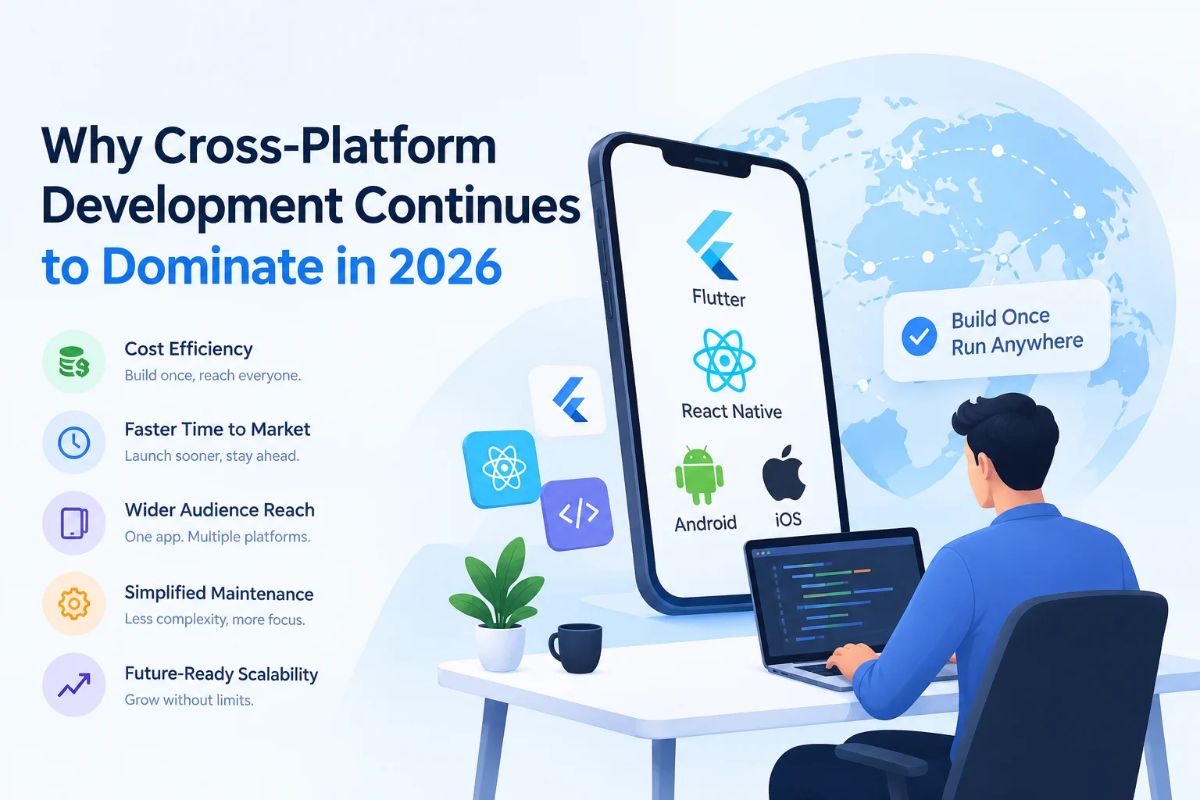
In 2026, the demand for fast, flawless mobile experiences is higher than ever, leaving businesses with no room for delayed launch timelines or split engineering efforts. Building separate native apps for every platform is quickly becoming a thing of the past. Cross-platform development has transformed from a practical shortcut into the ultimate power move for scaling digital products efficiently. With today’s high-performance frameworks, companies can now reach wider audiences without compromising on native-level speed or quality.
In this blog, we explore the tech trends, framework evolution, and cost-efficiency driving cross-platform dominance today, giving you actionable insights to streamline your app strategy for the year ahead.
1. Technical Paradigm Shifts Reshaping Cross-Platform Frameworks
The modern architectural evolution of mobile systems has neutralized historical complaints regarding rendering delays, bridge overheads, and hardware access boundaries. Native-like performance is no longer a goal; it is the default standard for modern cross-framework environments.
- Elimination of the Asynchronous Bridge: Older framework versions depended heavily on passing serialized data back and forth through asynchronous runtime bridges. This frequently caused visible UI hitching during swift finger swipes or multi-layer screen transitions. Modern Direct JavaScript Interface (JSI) configurations and direct memory pointers give execution runtimes immediate, zero-latency pathways to native C++ functions.
- GPU-Accelerated Vector Graphics Pipelines: Advanced graphic execution layers, including Google’s Impeller engine, rely on ahead-of-time (AOT) shader compilation. This architectural design eliminates unpredictable mid-session compilation stutters, holding stable 120Hz display refresh performance across intricate vector animations and live reporting dashboards.
- Logic-Only Shared Codebases: Modern engineering practices give leaders the freedom to separate application design cleanly. Core business rules, API networking routines, and local database storage operate inside one shared module, while screen rendering combines native platform interface elements with cross-platform canvas layers.
- Instant Native Feature Support: Current framework releases connect directly with platform-level developer kits. Brand-new platform tools; ranging from updated background alerts to biometric hardware locks, become usable right away without relying on third-party plugin maintenance.
2. Framework Evaluation Factors for Business Choice
Selecting the correct technical stack depends on business goals, existing team expertise, and application complexity. The modern framework landscape provides dedicated strengths tailored to distinct product requirements.
- Flutter (Dart): Relies on a custom GPU Skia or Impeller canvas rendering strategy, achieving roughly 97 percent native performance execution. It is the ideal product category for rich brand design, custom consumer interfaces, and simultaneous web or desktop expansion through unified multi-surface codebases.
- React Native (TypeScript): Utilizes native operating system views powered by the Fabric engine, delivering approximately 94 percent native performance execution. It serves as an exceptional choice for dynamic e-commerce applications, content-heavy feeds, and ecosystems that benefit from extensive web code sharing.
- Kotlin Multiplatform (KMP): Combines shared core business logic with fully native user interface layers, reaching up to 99 percent native execution speed. It stands out as the premier architecture for enterprise applications and security-first fintech solutions requiring raw hardware access.
3. Financial and Operational Economics of a Unified Codebase
Engineering strategy in fast-moving industries requires continuous capital efficiency and optimized developer allocation. Maintaining separate platform divisions multiplies organizational drag, introduces logic discrepancies, and inflates burn rates.
- Consolidated Talent Management: Structuring development around a single product squad simplifies team administration. Companies can hire talented software professionals fluent in one main programming ecosystem, avoiding the need to balance separate iOS and Android departments.
- Accelerated Feature Velocity: Feature rollouts happen at the exact same moment across iOS, Android, and web platforms. Adjusting core data models or platform authorization rules requires making the modification just once, preventing features from falling out of sync across devices.
- Decreased Long-Term Maintenance Overhead: Quality assurance testing and bug-hunting passes demand far fewer resources. Issues uncovered in main business logic are patched at the source, which immediately improves app stability on every supported platform.
- Faster Time to Product-Market Fit: Emerging ventures and product innovation groups can test market hypotheses in shorter feedback loops. Pushing quick updates directly to mobile marketplaces gives teams immediate real-world usage signals to adapt app functionality within weeks rather than waiting several months.
4. Deep Integration with On-Device AI and Edge Processing
Modern applications demand real-time intelligent features operating locally on client hardware. Cross-platform technologies have adapted to execute intensive machine learning algorithms directly on platform Neural Processing Units (NPUs).
- Zero-Latency Local Machine Learning: Modern multi-platform plugins connect directly with native machine learning interfaces like Apple’s CoreML and Android’s NNAPI. On-device image processing, secure identity verification, and instant text interpretation run locally without sending data off the physical phone.
- Context-Aware Dynamic User Interfaces: Systems dynamically adapt navigation structures, layout tokens, and component sequences based on predictive behavioral models, delivering personalized user interactions on the fly.
- Edge Vector Search Capabilities: Compact embedded vector databases execute seamlessly inside unified app runtimes. App users run deep context-based searches while offline, keeping personal information secure on the device while cutting down on expensive server calls.
5. Architectural Blueprints for Scalable App Ecosystems
Building sustainable digital products requires modular software engineering principles. A clean architecture ensures long-term system health, enabling engineering teams to scale without refactoring the foundational codebase.
- Strict Clean Architecture Layering: Decouple domain business logic completely from presentation UI layers. This isolation allows developers to swap UI components or upgrade framework versions without altering core application rules.
- Unified State Management Systems: Implement deterministic, single-source-of-truth state container architectures. Predictable state flows eliminate synchronization glitches across complex user interactions and background processing tasks.
- Automated Continuous Delivery Pipelines: Utilize unified continuous integration workflows. Automated unit testing, performance profiling, static code auditing, and deployment builds run simultaneously for both major mobile platforms through a centralized script.
6. Guide for Choosing a Strategic Framework
You should determine your architectural options based on your business needs with the help of this guide:
- Choose Flutter if your core value proposition relies heavily on bespoke visual identity, high-frequency animations, complex canvas rendering, or simultaneous desktop and web companion deployment.
- Choose React Native if your company has professional skills in the field of JavaScript or React web platforms, needs to move quickly from the web version to a mobile app, or plans to create an e-commerce site based on content.
- Choose Kotlin Multiplatform in case you need to modernize business applications with high-performance native execution algorithms or you want to keep strict rules for running business processes and at the same time you want to preserve the native interface at the same time.
Conclusion
Cross-platform development is no longer just about compromises and sacrifices; it is a distinguishing advantage for proactive organizations that want to deliver efficient and scalable digital solutions. By improving the engineering process, lowering operational costs, and using some of the best frameworks, companies can launch products with the highest performance. At Devherds, we simplify complex engineering and create amazing digital solutions from difficult technological paths. Our talented engineers have a lot of skills in creating scalable architecture, designing beautiful UI, and integrating efficient mobile systems according to your requirements. Whether you are going to launch a new app or modernize your existing platform, we offer excellent technical management services.
Want to build your mobile strategy the right way? Schedule your free 30-minute consultation with us right now and learn more about ways to speed up the development process.