What should be done when your company’s software creates more issues than it solves? As business needs evolve, software that once made daily work easier can start creating obstacles instead of helping employees get things done. It may occur that your staff has to work around missing functionalities, cope with inflexible processes, or pay for software they do not use enough anymore. Although switching software seems the most logical step, finding a proper software product requires some deliberation. You must understand what you need before buying another off-the-shelf product. The blog is about the aspects of off-the-shelf software and whether custom software might suit your company better.
Why Off-the-Shelf Software Does Not Always Meet Business Needs
Ready-made software presents a practical solution for firms with established needs who want to avoid spending on software development. Software for accounting, CRM, project management, and inventory checks can easily cater to the basic functions of different organizations. At the same time, these products are created for a diverse audience of businesses, and thus, they don’t concentrate on particular processes. As companies move forward, inherited processes may require modifications in order to become more customized. For instance, initially, the company may rely on standard software for order management.
In the future, however, the company can find out that it needs more sophisticated features, such as automatic order dispatch, tailored approval rules, and real-time inventory synchronization. If the software does not meet such needs, workers may either buy other applications or use tedious manual processes to carry out their work. Therefore, ready-made software is not necessarily a bad solution for a business. The problem is whether it can keep up with business needs as they evolve.
Signs Your Business Has Outgrown Off-the-Shelf Software
Recognizing software limitations early can help businesses avoid unnecessary expenses and disruptions. The following signs indicate that your existing solution may no longer be the right fit.
1. Employees Depend on Manual Workarounds
In the absence of necessary options, employees resort to other ways of executing their assignments. Employees may resort to copying data from one spreadsheet to another, entering common data into different systems, or requesting approvals via email.
Although these methods may not appear problematic per se, in the aggregate they add to the administrative burden and increase the risk of making mistakes. If the workforce needs to frequently find substitutes for system inadequacies, it will make sense to evaluate other alternatives.
2. Integrations Between Applications Are Difficult
Modern businesses often use different applications for different purposes. An organization can use one type of application for managing customers, another for accounting, a third for inventory, and a fourth for communication and reports.
However, if all these applications cannot communicate properly with each other, certain departments may work using old and irrelevant data. Third-party connectors and APIs can solve many integration problems; however, not every software may support one’s integrations. Custom development will be a more suitable solution for integration of important two working systems utilizing some special data formats and procedures.
3. Software Costs Keep Increasing
A low subscription fee does not imply that the long-term costs will be low. Companies may incur extra charges when engaging extra users, storing more data, accessing advanced features, receiving premium support, or integrating systems.
As companies grow, these recurring costs can become hard to justify, especially when the software is inadequate in some critical functions. “Organizations can calculate the total cost of ownership, which includes subscriptions, implementation, training, integration, or time loss caused by the administrative limitations.”
4. Business Growth Creates Performance or Functionality Problems
When there is an increase in transaction volume, the application that worked well for the small team may suffer. Some vendors offer solutions or upgrades while others impose technical restrictions.
Businesses should find out if an upgrade to a more advanced plan will help before they consider switching software programs. If the platform cannot support growth, it is time to consider custom development.
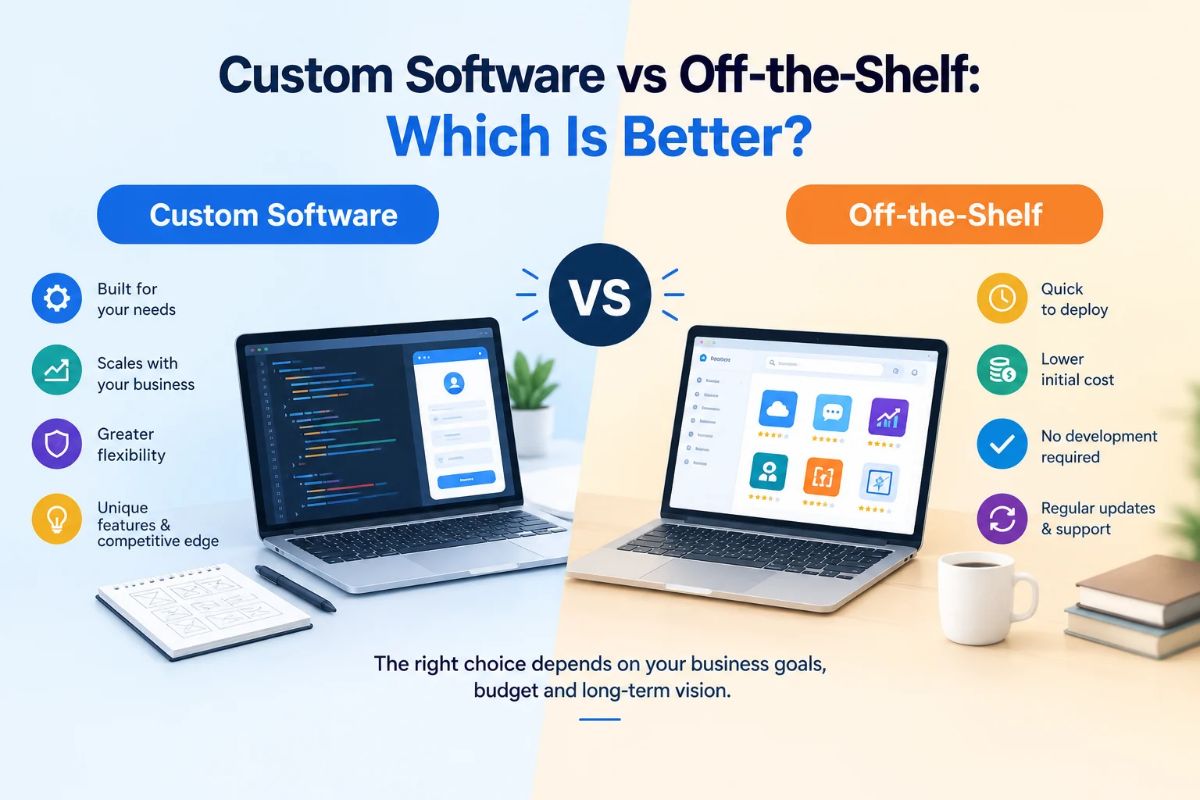
Custom Software Development vs. Off-the-Shelf Software
Both options can support business operations, but they differ in flexibility, implementation, cost, and control.
Off-the-Shelf Software: Convenience and Faster Implementation
Ready-made software is usually the practical choice when a company needs standard functionality and wants to begin using a solution quickly.
Its main advantages include:
- Lower initial investment: Purchasing a subscription is generally less expensive upfront than commissioning a new application.
- Quick deployment: Existing features allow businesses to get started with relatively little development work.
- Vendor-managed maintenance: Providers typically release updates, fix bugs, and maintain the underlying product.
- Established functionality: Businesses can evaluate existing features before committing to a solution.
- Accessible support: Many vendors offer documentation, training resources, and customer assistance.
However, customization may be limited, and businesses must work within the provider’s product design, pricing structure, and development roadmap. Additional tools may also be necessary when the platform does not cover every operational requirement.
Custom Software Development: Flexibility and Greater Control
Custom software is developed around a business’s specific objectives, workflows, and technical requirements. Instead of adjusting every process to fit a standard product, companies can define the functionality their teams need.
Its main advantages include:
- Business-specific features: Developers can create workflows that reflect actual operational requirements.
- Flexible integrations: The application can be designed to connect with existing systems, databases, and third-party services.
- Scalability planning: The architecture can account for anticipated growth in users, data, and transactions.
- Greater control over development: Businesses can prioritize features and plan future improvements according to their needs and available budget.
- Tailored security controls: Access permissions, audit logs, and data-handling procedures can be designed around relevant security requirements.
Custom development also involves responsibilities. Businesses must account for design, testing, hosting, maintenance, and future updates. Ownership of the source code and intellectual property should be clearly defined in the development agreement.
When Is Custom Software Development the Better Choice?
Custom development deserves serious consideration when software limitations affect essential business activities rather than simply creating minor inconveniences.
Your Business Follows Specialized Workflows
There are industries that use certain workflows that cannot be executed well by standard software applications. Take a logistics company, for example. It might require the use of dispatch software that takes into account the timings of delivery, the capacity of vehicles, the availability of drivers, and the routes changing from time to time.
Custom software would be able to combine everything listed above in one application so that specialized solutions are not needed anymore, with all the manual coordination of the activities.
You Need Features That Existing Products Cannot Provide
There are situations when a company needs unique dashboards, various mechanisms for approvals, customer portals, or specific functionality reserved for a certain sphere of activity. When a solution is unable to offer such features, at least via configuration or some additional add-ons, custom systems make sense.
Another crucial consideration is whether the sought capabilities will really solve a real business problem. Creating an opportunity for capabilities implies spending money on implementation without getting any profit as a result.
You Need Better Integration Across Business Operations
The results of isolation of the departments and incompleteness of applications can lead to information gaps. Customized solutions can offer connectivity of systems to create automation of data exchanges, because the required APIs, access, and authorization are provided in the solution.
As an example, integration of customer orders with inventory and accounting systems can prevent the need for the duplicate input of information and ensure more consistent data processing by the company’s employees.
Your Long-Term Requirements Demand Greater Flexibility
As organizations prepare for new service launches or target additional markets and reorganize their operational structures, it is evident that they need software capable of operating in accordance with organizational changes. Custom software development enables the incorporation of improvements according to business priorities in the long term.
However, the extent of flexibility depends not only on whether the application is custom-made or not but on how well developed its architecture and documentation are and on the quality of maintenance service as well.
Conclusion
Choosing the right software means finding a solution that fits your business needs, supports daily operations, and adapts as your company grows. When off-the-shelf tools create ongoing limitations, custom software development can offer greater flexibility and control. Devherds helps businesses build tailored digital solutions through custom software development, application development, system integrations, and ongoing technical support. By focusing on your workflows and goals, our team can help develop software that addresses practical challenges and supports long-term growth. Connect with us to discuss your custom software development needs.