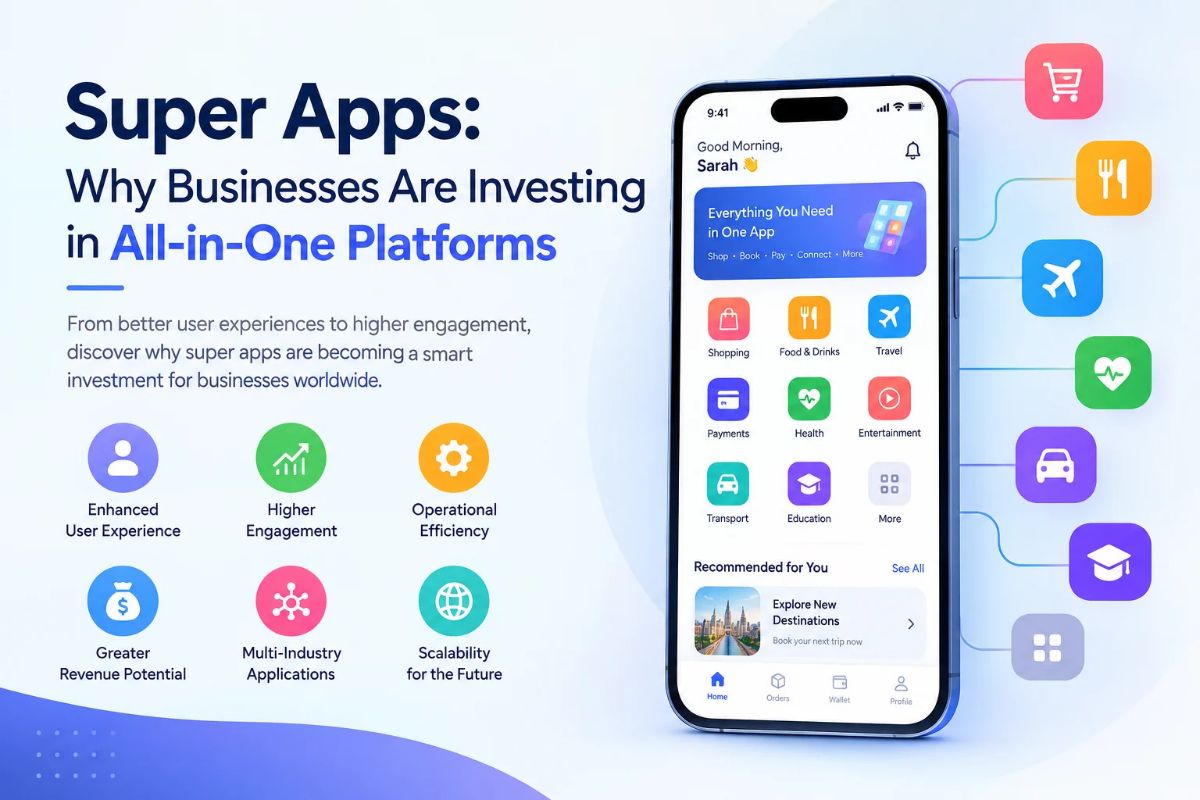
Consumers rarely want to juggle several apps for tasks that are connected in their everyday lives. They may use one platform to order food, another to make payments, and another to book a ride, even when those activities happen within the same routine. Businesses are responding by bringing related services together under a single digital experience. Super apps are emerging from this shift, combining multiple functions while keeping users within one platform. For companies, the model can open new opportunities around engagement, cross-selling, customer data, and operational efficiency. This blog explores how super apps work, why businesses are investing in them, and what companies should consider before building one.
What Is a Super App?
A multi-service platform functions as a unified digital ecosystem bringing numerous offerings, features, or financial transactions together rather than forcing users to install distinct applications for every distinct requirement.
A typical ecosystem generally combines utilities such as:
- Digital payments and financial products
- Food and grocery delivery
- Ride booking and transit solutions
- Retail shopping and digital marketplaces
- Travel reservations and ticketing
- Instant messaging and communication channels
- Loyalty schemes and reward programs
The crucial difference is not merely the sheer volume of features. An all-in-one ecosystem links those functions through a single profile, interface, and shared architecture, creating a more fluid journey while granting businesses multiple touchpoints across the consumer lifecycle.
Why Are Businesses Investing in Super Apps?
The expanding enthusiasm for unified digital environments closely reflects how modern enterprises approach user retention, income generation, and scaling. Rather than launching isolated software for every separate requirement, organizations can construct a comprehensive ecosystem around an established user base, securing strategic advantages that legacy single-purpose models cannot replicate.
One Platform Can Serve Multiple Customer Needs
A consumer might initially download an application for one precise reason. For example, a user could sign up to buy groceries but later discover integrated payment options, restaurant delivery, or subscription perks inside that same software.
That broader utility gives individuals compelling incentives to return. Businesses can consequently transition past single-purpose tools and establish an environment supporting multiple phases of the consumer journey without driving users to external competitors.
Higher Customer Engagement and Daily Habits
When software delivers numerous practical services, users encounter frequent incentives to interact with it repeatedly.
An individual opening a program solely for meal delivery might visit daily if that identical platform also handles utility bills, transit bookings, shopping, or financial transfers. Increased utilization creates steady touchpoints between the consumer and the enterprise, turning a periodic utility into an indispensable daily habit without requiring any extra downloads.
Cross-Selling Becomes More Practical and Natural
Integrated ecosystems likewise establish an organic setting for cross-selling that feels intuitive rather than pushy.
A user executing a financial transaction might be introduced to complementary banking services. Someone reserving a trip could receive relevant travel perks, while a grocery shopper discovers household goods or membership discounts.
Because these services reside within the same framework, companies present targeted offerings based on active behaviors rather than restarting the acquisition cycle from zero.
Data Synergy and Deeper Consumer Insights
Operating multiple verticals under a single roof grants corporations a comprehensive perspective on user behavior that fragmented apps miss completely.
- Behavioral Mapping: Enterprises understand how individuals navigate between distinct features, tracking how a financial transfer influences retail purchases or travel bookings.
- Friction Reduction: Locating where users drop off during multi-service transactions allows product teams to optimize the user flow.
- Personalized Recommendations: Unified data pools empower brands to tailor suggestions with remarkable accuracy, elevating conversion metrics across every integrated vertical.
Lower Customer Acquisition Costs
Acquiring new users in a congested digital market demands heavy marketing spending. Multi-service platforms radically alter this economic equation.
Once a consumer is captured via a high-demand core feature, such as ride-hailing or food delivery; introducing additional services incurs virtually zero extra acquisition expenditure. The existing user base functions as an organic engine for growth, letting organizations maximize return on investment while widening their market share.
What Businesses Should Consider Before Building a Super App
Launching a multi-service platform takes a lot more than just gluing a bunch of services into a single interface. Companies need to look closely at technical demands, daily operational workflows, and the end-user experience long before coding kicks off. Tackling these elements right out of the gate keeps unnecessary friction at bay as the product grows.
Managing a Large Feature Set
An all-in-one platform can get cluttered and messy fast if teams pile on features without a solid game plan. Every single addition tacks on extra responsibilities for engineering, QA testing, support teams, analytics tracking, and ongoing maintenance.
Because of this, companies are better off zeroing in on utilities that genuinely fit together naturally rather than trying to launch every conceivable feature on day one. A streamlined initial release leaves plenty of room to scale up organically based on what users actually want and use.
Security and Data Protection
Since multiple services tie back to one primary user account, security has to be baked in from the very foundation. A single weak spot in one module could expose connected services and compromise sensitive personal data across the board.
Organizations need to plan ahead for robust authentication protocols, strict access controls, encryption, secure API gateways, and proactive monitoring from the earliest design phases.
Scalability and Infrastructure
Different features inside a multi-service app experience wildly different traffic spikes. A payment gateway, a grocery delivery tracker, and a shopping marketplace will each pull on system resources at different times, making elastic infrastructure an absolute must.
The backend needs to handle high-demand surges smoothly without letting heavy traffic in one area drag down performance elsewhere. Teams also have to design the system so new features can drop in cleanly down the road.
Keeping the User Experience Simple
Packing more features into an app doesn’t automatically make it a better product. When too many tools fight for screen space, navigation gets messy, and users end up struggling to find what they actually came for.
Clean information architecture, intuitive menus, smart shortcuts, and sharp search bars help keep the entire experience feeling light and straightforward, even as the ecosystem expands.
Defining the Right Product Strategy
Before writing a single line of code, leadership needs to define what the platform is meant to accomplish and which services back up that goal. Walking through a few core questions helps nail down the roadmap:
- What specific user pain points will the platform fix?
- Which services truly belong side by side?
- Should features be built in-house or integrated via third-party partners?
- What payment gateways and sign-in methods are mandatory?
- How will data privacy be maintained across connected modules?
- What kind of backend architecture will support long-term growth?
- Which features make the cut for version one?
Kicking things off with a tight, focused group of core services is usually way more practical than trying to build a massive digital empire overnight. Once the foundation is rock-solid, expanding into new verticals becomes much smoother as real-world data and user demand greenlight the next moves.
Conclusion
Super apps are reshaping how businesses deliver digital services by bringing multiple customer needs into one connected platform. By combining convenience with personalized experiences, they create opportunities to improve engagement, diversify revenue, and build stronger customer relationships. However, realizing these benefits requires a well-planned development strategy, seamless integrations, robust security, and an architecture that can support future growth. For businesses looking to turn this vision into a functional, scalable product, Devherds offers the technical expertise to bridge the gap between an idea and its successful implementation. We also provide a free 30-minute strategy session where our experts help you refine your super app concept, explore the right development approach, and understand the right development path for your business.
Ready to build your all-in-one platform? Get in touch with us today.